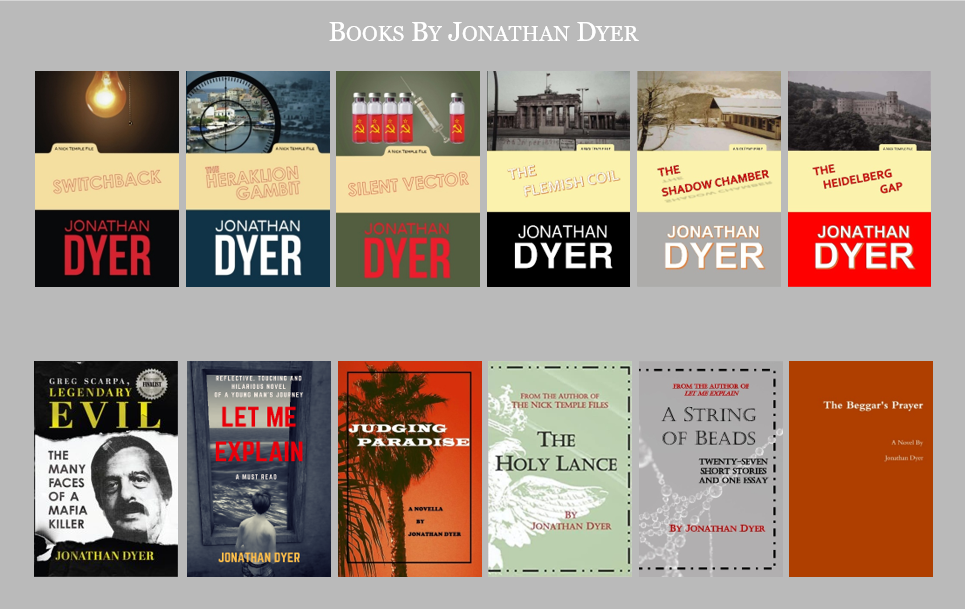
In retrospect, I probably should have included an introduction to Greg Scarpa, Legendary Evil that reads: “I consulted in excess of 300 potential sources including, but not limited to, thousands of pages of state and federal government documents, more than 120 newspaper and magazine articles, more than 40 reported court cases, every relevant book, government report, scholarly article, and database I could get my hands on, and hours of recorded interviews, news reports, and special reports. I did the above, and more, so you don’t have to.” Instead, I attempted to describe the book’s purpose in chapter 1 in a less aggressive fashion.
Simply put, my goal when writing the book was to present as much accurate information, i.e., separating fact from legend, about Greg Scarpa’s life as I could based on what I was able to access by whatever medium. That goal required review of everything I could find (research) with a critical eye (critique) while attempting to determine in broad outlines what the reasonably verifiable information revealed about Scarpa and those around him (analysis).
While there are probably as many ways to approach writing nonfiction as there are subjects and authors, my approach arose organically as I researched Scarpa’s life. Honestly, when I began the project I did not have a specific framework in mind. While I had never written a book-length piece of nonfiction before, I had certainly read thousands of nonfiction articles and books of every possible length, from single paragraph newspaper articles to multivolume works of historical scholarship. Given that background, I decided early on as a general principle to be as clear as possible regarding what information about Scarpa I deemed reliable and what information I did not and why.
As I researched, I came to the conclusion that even well-meaning chroniclers of the events in Scarpa’s life erred, in my view, factually from time to time, some more than others and some more deliberately than others. The book, as a result, is full of critique of the sources I encountered and used. Finally, as I separated the wheat from the chaff, so to speak, I used what I considered those facts that were reasonably reliable to drive my own analysis. That analysis at times agreed with some of the sources I consulted and often it did not. After all, analyses driven by differing sets of facts are sure to differ. In addition, the process of research and critique often suggested a fresh analysis that I had not come across in my research which I felt was supported by those same reasonably verifiable facts.
The combined result of all of the above is a book to which I devoted more than two years of my life. And of course my hope is that readers will approach the book’s substance, after reading chapter 1, with the above in mind. As a final note, more than a month ago I made chapter 1 available for free on my Independent Author Network page for potential readers to download. My purpose in doing so was to let readers know what they would be in for should they decide to go ahead a purchase the book. I hope it helps!